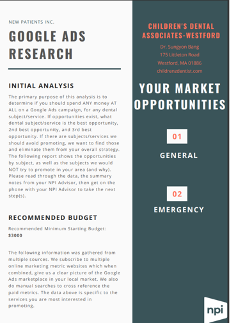
A Google Ads Initial Analysis (IA) is a report that we provide to identify qualified prospects for Google Ads. It goes over service-specific competitor research, keyword traffic, and estimated budgets.
What’s Inside?
Cover Page – What to Expect & Overall Recommended Budget
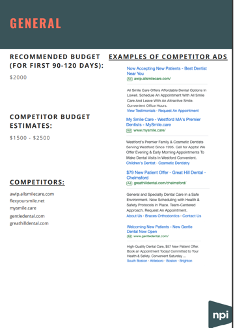
Budget Estimates & Competitor Research To find the most relevant competitor data, we perform our research at the same time ads WOULD BE running if the prospect was active. This ensures the most accurate recommended budget and strategy.
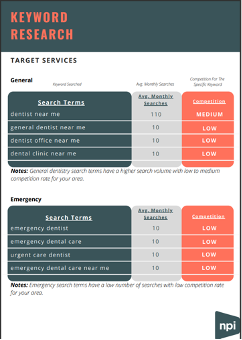
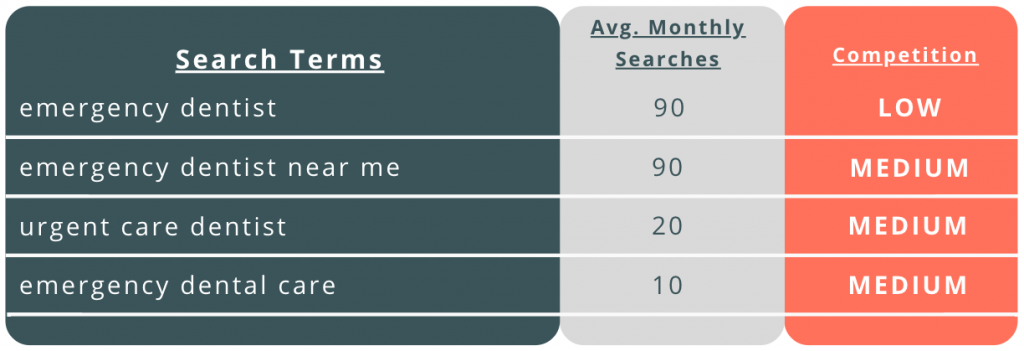
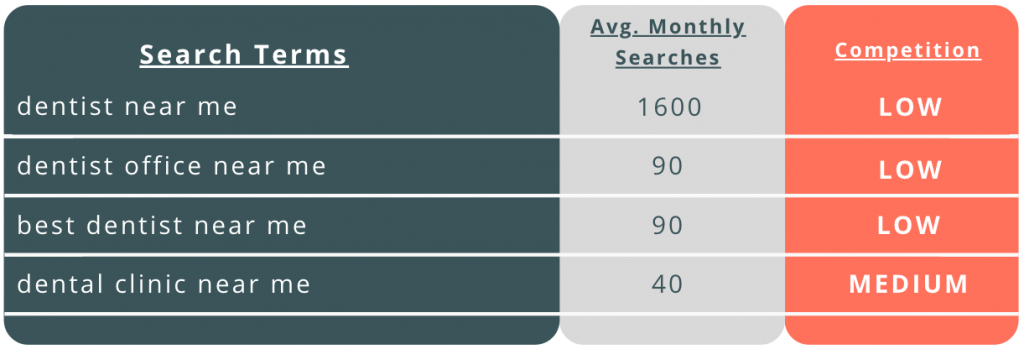
Keyword Traffic An important factor in the success of a Google Ads campaign is the amount of traffic certain keywords get each month. With Google’s Keyword Planner we can identify the least competitive, highly searched services to target.
Recommended Budget
The Recommended Budget on the Cover Page is what is recommended to be the monthly budget for the first 90-120 days. This is just a starting point. After the initial ramp-up period, the optimization team will be able to further advise on budget increases/decreases.
Data Lifetime
The information resulting from the IA should only be considered for the following 30 days. After that, you’re risking the data not being as accurate. Ideally, even an active Google Ads client should have their market re-evaluated every 4-6 months.
Competitors & Strategy
In addition to knowing WHO the competitors are and HOW MUCH they are estimated to spend each month, reviewing a competitor’s ad copy will also tell you if the market is predominantly shoppers. If you see a lot of $69/$79/$89 exam deals or $500 off an Implant campaign, it will be hard to direct search traffic to an ad that does not include a price incentive. In this scenario, if the prospect doing the Initial Analysis DOES NOT want to include deals, then we risk not being able to spend their ad budget.
Analyzing Ads Challenge!
Look at the competitor ad on the right. Based on its contents, what observations would you communicate to the prospect?
How Did You Do?
When you’re ready, flip the ad over to see all the take-aways!
Competitor Ad
Using a Deal - it might be hard to compete without a price incentive.
Using Website - not optimal. A landing page provides better tracking and quality score (lower cost).
Who is a Competitor?
It is easy to identify a competitor in the real world, but it’s not so easy identifying competitors in the auction world without doing the proper research. In a Google Ads auction, your competition could mean the doc a mile down the road (that does know how to run an ad campaign), and then you have the dentist 40 miles away, that doesn’t know how to target properly, bidding on the keywords in your area and artificially increasing your costs.
Traffic & Expectations
The bottom line is, if there isn’t anyone searching for the service on Google, there will be no clicks, therefore no ad budget spent. To guarantee expectations are realistic, we research the search traffic for every prospect’s unique market.
There are many factors that determine the best strategy. Google Ads is not one-size-fits-all. When looking at the traffic numbers above, your instinct might be to go all-in on General — look at all those searches! This is where the doctor’s individual goals and strengths come into play.
Maybe they have unique hours of operation? If they’re open late, on weekends, or can accommodate “same-day” emergencies, then Emergencies would be the best service to go with. Even though there is a lower volume of searches, promoting the ability to accommodate patients outside the normal office hours will increase the chances for a conversion. You have now given the consumer a reason to choose you over a competitor.
You will also want to keep in mind the value of the service when comparing traffic numbers. The value of an implant patient is MUCH higher than a general new patient cleaning.